

First One
This is literally my first post and I don't have title. Read on..

I really believe in God. Truly. I believe in a God who is good all the time. Please don’t judge me on my bad theology. I know it’s bad theology and I’m going to say it anyway. I believe in a parking space God, and most of the time, I do get a good parking space. And I always say thank you, always. If I don’t get a good parking space, which is, of course, relative, because any parking space is good, especially during the holidays, I park in the back of the lot and walk and say thank you again because I got a little exercise.
And I believe in a God that reminds me through other humans things I need to remember. Yesterday I was listening to a podcast on expanding God consciousness, (so pretentious, I know, but hear me out. I am a recovering alcoholic with money and relationship issues, a bonafide membership of three 12 step-programs, and yes, I need another one, but that’s for another post. One of our steps is about seeking through prayer and meditation to improve our conscious contact with God, hence, the podcast on raising God consciousness!) And the workshop leader read the St. Francis prayer at the end of the podcast.
Lord, make me an instrument of your peace: where there is hatred, let me sow love; where there is injury, pardon; where there is doubt, faith; where there is despair, hope; where there is darkness, light; where there is sadness, joy. O divine Master, grant that I may not so much seek to be consoled as to console, to be understood as to understand, to be loved as to love. For it is in giving that we receive, it is in pardoning that we are pardoned, and it is in dying that we are born to eternal life.
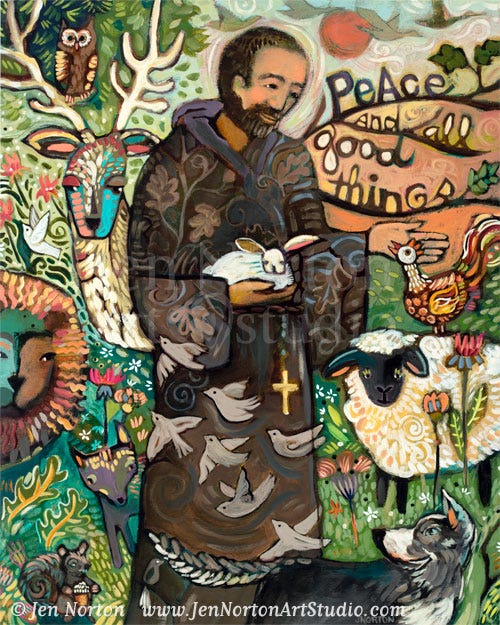
It would be easy to justify my hatred, injury, doubt, despair, darkness, and sadness at this moment in our history as a culture and a nation depending on where you are sitting on the political teeter totter. I, for one, had a bleak couple of weeks after the election. I exhausted myself with political news after the election seeking meaning and understanding regarding how we as a nation chose to sacrifice care, compassion, and dignity for every human being to be led by racism, sexism, transphobia, homophobia, xenophobia, greed, and malice.
It would be easy to fall into cynicism and bury my head in the sand for the next year, and then I read the poem that is the prelude to John’s gospel again.
In the beginning was the Word and the Word was with God and the Word was God. The Word was with God in the beginning. Everything came into being through the Word, and without the Word nothing came into being. What came into being through the Word was life, and the life was the light for all people. The light shines in the darkness, and the darkness doesn’t extinguish the light. (John 1:1-5)
The incarnation. Logos takes on flesh. Light, life, love, takes on flesh in the human being of Jesus. Miraculous.
Writer and former pastor, Rob Bell, in his book What is the Bible? says that when we reduce Jesus to master teacher, inspiration for social justice, or profound mystic with deep insights into the infinite, which are all true about Jesus, we are neglecting the real message of Jesus. Bell says, “over and over again, Jesus insists that he's doing something far more significant and elemental than all that; he keeps claiming that something new is happening in the world and it’s happening through him (Bell, p.158).”
Bell writes: “Something involving heaven and earth coming together, the divine and the human in the same place— people have described it in lots of different ways (p. 160).”
We call it the incarnation. This is what we are celebrating, reflecting on, contemplating these weeks after Christmas. God with us.
Eugene Peterson, author of The Message: The Bible in Contemporary Language wrote the opening to John’s Gospel like this:
The Word was first, the Word present to God, God present to the Word. The Word was God, in readiness for God from day one. Everything was created through him; nothing—not one thing! — came into being without him. What came into existence was Life, and the Life was Light to live by. The Life-Light blazed out of the darkness; the darkness couldn’t put it out. (John 1:1-5)
And then he says, The Word became flesh and moved into the neighborhood. (John 1:14)
Heaven and Earth, the Divine and the Material, Sacred and the profane, became flesh and moved into the neighborhood. Bell says the Incarnation raises all kinds of questions for us. Questions about the very nature of what it means to be human. Are we a mass of bones and blood, sinew and muscle, organs, and systems, or are we more? Bell wants us to reflect on the idea that perhaps something divine, infinite, eternal resides in every one of us? “Are we just dust, or are we also spirit” (Bell, p. 160).
We are more than sinew, bone and blood. We are made in God’s image. As Jesus, the baby born in the manger, is the expression of the divine and human, so are we.
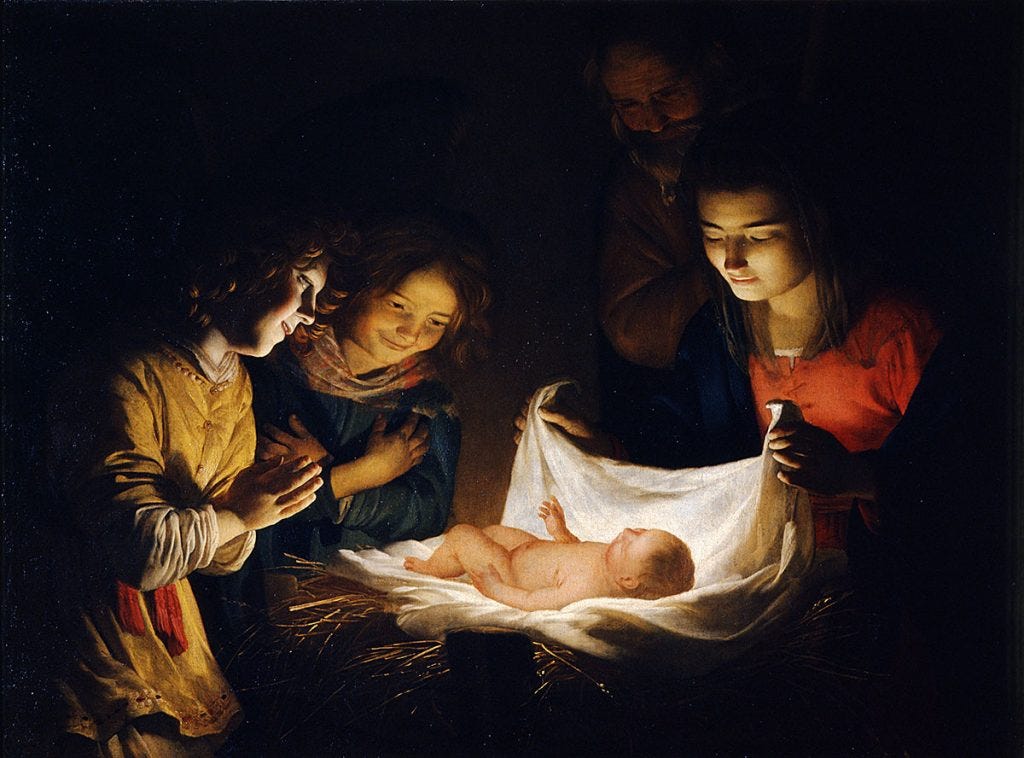
The incarnation of God in Christ is the hope that the divine can work in us humans to make something new in the world. The belief that God is in all things, everywhere, and in us, that the true light will enlighten us, shine through us and dispel darkness wherever we go, that belief can create space in our heart that allows us, if we let it, to be love, pardon, faith, hope, light and joy in the world.
If we are going to avoid the trap of cynicism and pessimism in the coming days, months and years, we will have to remember our true nature, our divine nature. We will have to set aside our grievances, resentments and fear, which is no easy task, and channel light, life and love. We will have to practice, and oh my word, it will take a lot of practice, to seek to console rather than be consoled, to understand rather than be understood, and to love rather than to be loved. For it is in giving that we receive, it is in pardoning that we are pardoned, and it is in dying that we are born to eternal life. Amen.